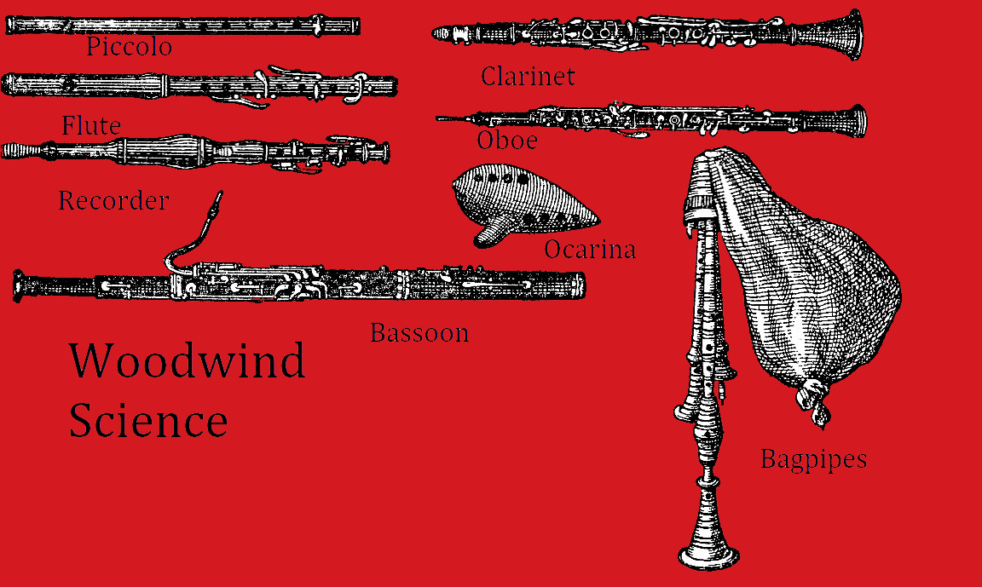
Each woodwind instrument has a series of either keys or rings (or holes) that are either depressed or covered (we will call these keys/rings, “activated”). The particular structure of the instrument gives the number of keys and rings to be activated for each note. In order to do comparisons of fingering structures in a computer database, it is desirable to be able to encode the specific activation sequence for each given note on an instrument.
We propose the following scheme:
1. Number the keys/rings starting right-to-left, bottom-to-top, underside-to-override. This gives an unambiguous numbering sequence. Different people may have slightly different numbering schemes, but hopefully, it will become standardized.
2. If the key or ring is activated for a particular note, designate it by a 1; if it is not activated, designate it by a 0. This gives rise to a unique binary number for each fingering for that note.
3. These binary numbers can be stored either as binary or decimal numbers, along with the number of possible activation sites (total keys and rings) for the instrument.
Example:
Clarinet numbering:

Low C on the clarinet would have the binary fingering representation as follows:
Thus, low C has the binary representation, above, and a decimal representation of 2^13+2^19+2^20+2^23 = 9969664. Obviously, there may be many different ways to play a given note, but each will be assigned a unique binary and decimal number by this method. This method will work with any woodwind instrument in any time period.
For purposes of musical acoustics, only the opening or closing of drilled holes is important and a similar method may be adopted, where the specific keys or rings numbers are unimportant (since some of them open the same holes, after all). Only the tone holes are numbered. The fingering and acoustic binary representations are expected, except for the simplest keyed woodwind instruments such as the recorder, to be different.